
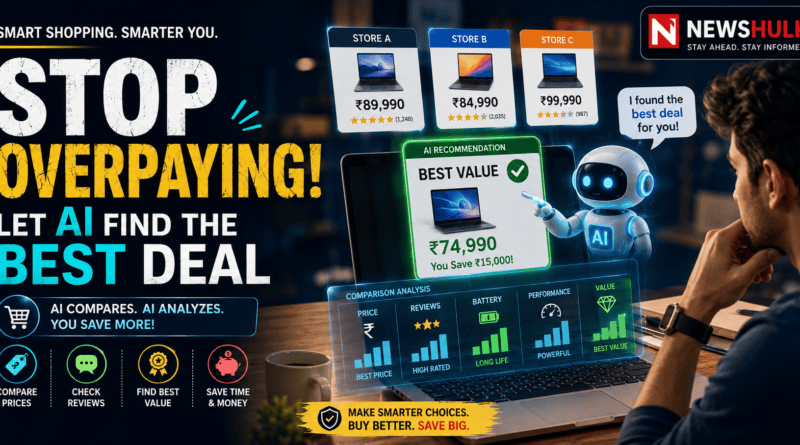
I Was About to Buy the Wrong Laptop… Until AI Saved Me ₹25,000
💻 I Almost Clicked “Buy Now”…
It was nearly midnight.
Like millions of people, I had far too many browser tabs open.
Amazon.
Flipkart.
The brand’s official website.
A couple of YouTube reviews.
Reddit discussions.
Tech blogs.
And yet…
I still couldn’t answer one simple question.
Which laptop was actually worth my money?
One model had better reviews.
Another had more storage.
A third was ₹20,000 cheaper.
The more I researched…
The more confused I became.
Sound familiar?
If you’ve ever spent hours comparing products online, you’re not alone.
Today, buying the right gadget isn’t difficult because there are too few options.
It’s difficult because there are too many.
That’s when I decided to let AI Shopping Assistant help me shop.
I wasn’t expecting much.
What happened next completely changed how I buy expensive products.
Google Flow AI Review (2026): Can One Prompt Create a Hollywood-Style Movie?
🤖 Shopping Has Changed Forever
For years, shopping meant reading hundreds of reviews.
Watching endless YouTube videos.
Comparing technical specifications you barely understood.
Now imagine asking one question.
“Which laptop gives me the best value under ₹1 lakh for video editing and office work?”
Within seconds…
AI summarizes:
✅ The strongest options
✅ Real customer feedback
✅ Performance differences
✅ Better alternatives
✅ Whether you should buy now or wait
For the first time…
Shopping started feeling less stressful.
Best Budget Airlines for International Travel in 2026 | Top 10 Cheap Airlines
💰 The Biggest Mistake Most People Make
Here’s something interesting.
Most people compare…
Price.
Smart shoppers compare…
Value.
A ₹1,20,000 laptop isn’t automatically better than one that costs ₹90,000.
Sometimes…
You’re simply paying for a logo.
AI doesn’t get emotionally attached to brands.
It compares specifications.
Performance.
Battery life.
Display quality.
Long-term value.
Things that actually matter after you’ve owned the product for six months.
🎯 Imagine This…
You’re buying your first laptop.
One friend recommends Apple.
Another says ASUS.
Someone else insists on Lenovo.
Reddit says something different.
YouTube reviewers disagree.
Instead of spending your weekend researching…
You ask AI.
“I’m a college student with a ₹70,000 budget. I need a laptop for coding, light gaming, and battery life.”
Instead of ten different opinions…
You receive one structured comparison.
That’s where AI becomes genuinely useful.
🧠 AI Doesn’t Replace Your Decision…
It Improves It.
This is an important distinction.
AI shouldn’t tell you what to buy.
It should help you understand why one product may suit your needs better than another.
That’s a much smarter way to shop.
🤯 So… Can AI Really Save You Money?
I decided to test it.
Not with a ₹500 gadget.
Not with a phone charger.
With something much more expensive.
A laptop worth nearly ₹1 lakh.
I gave AI one simple task.
“Find me the best laptop for video editing, office work, and light gaming under ₹1 lakh.”
Instead of giving me one recommendation…
It explained why certain laptops were worth buying…
…and why others weren’t.
That surprised me.
It wasn’t acting like a salesperson.
It felt more like a knowledgeable friend who had already done days of research.
💻 What AI Looked At (That Most Buyers Ignore)
Most shoppers compare only three things.
✔ Price
✔ RAM
✔ Storage
That’s a mistake.
AI looked much deeper.
Display Quality
Will you enjoy using this screen for five years?
Battery Life
Does it actually last all day…
…or only in advertisements?
Processor
Will it still feel fast after three years?
Build Quality
Is it plastic?
Metal?
Can it survive daily travel?
Real Reviews
Instead of only reading five-star reviews…
AI highlighted common complaints from real users.
Things like:
- Heating issues
- Fan noise
- Weak battery
- Poor customer service
Those are the details many buyers discover after spending their money.
🎯 The Question That Changed Everything
Instead of asking,
“Which laptop is the best?”
AI suggested asking,
“Which laptop is the best for YOU?”
That sounds simple.
But it’s incredibly powerful.
A college student.
A graphic designer.
A programmer.
A gamer.
A traveler.
They don’t need the same laptop.
The best product depends on the person.
AI understands that much better than a generic “Top 10” list.
🛍️ It Doesn’t Stop With Laptops
Then I became curious.
What else could AI help me buy?
The answer…
Almost everything.
📱 Smartphones
Instead of comparing 20 models…
AI narrowed them down to the three that actually matched my needs.
🎧 Headphones
Rather than focusing only on brand names…
It compared comfort.
Battery life.
Microphone quality.
Noise cancellation.
Real-world performance.
📷 Cameras
Need something for YouTube?
Travel?
Professional photography?
AI recommended different cameras based on how they’d actually be used.
🖥️ Monitors
Not every expensive monitor is better.
AI explained refresh rate, panel type, color accuracy, and eye comfort in plain English.
No confusing technical jargon.
⌚ Smartwatches
Fitness?
Battery?
Health tracking?
Notifications?
Instead of reading hundreds of reviews…
AI summarized the strengths and weaknesses in minutes.
⚠️ But Don’t Let AI Do ALL the Thinking
This is where many people make another mistake.
AI is incredibly helpful.
But it’s not perfect.
Sometimes product prices change overnight.
Sometimes a limited-time deal expires.
Sometimes a seller has poor customer service despite great reviews.
That’s why I always recommend one final check before clicking Buy Now.
Verify:
✔ Seller Rating
✔ Warranty
✔ Return Policy
✔ Latest Price
Think of AI as your shopping advisor…
Not your credit card.
🏆 AI + Human = Smarter Shopping
The best buying decisions don’t come from AI alone.
Or humans alone.
They come from using both together.
AI saves time.
You make the final choice.
That’s probably the smartest shopping strategy we’ll have for years to come.
📊 AI vs Traditional Shopping
| Traditional Shopping | AI-Assisted Shopping |
|---|---|
| 20+ browser tabs | One conversation |
| Hours of research | Minutes |
| Confusing specs | Easy-to-understand comparisons |
| Random opinions | Personalized recommendations |
| Trial and error | Better-informed decisions |
💡 Imagine This…
It’s Black Friday.
Thousands of deals.
Flash sales.
Limited-time offers.
Instead of opening dozens of tabs…
You ask:
“Which deals today are actually worth buying, and which are just marketing?”
That might be one of AI’s most practical uses.
Not replacing your decisions…
Helping you make better ones.
💰 10 AI Prompts That Could Save You Thousands Before Your Next Purchase
Here’s something I wish more people knew.
AI becomes incredibly powerful only when you ask the right questions.
Before you buy anything expensive, try asking these prompts.
💻 1. Which Laptop Gives Me the Best Value?
“Compare the best laptops under ₹1,00,000 for video editing, office work, and long battery life. Recommend the best value for money.”
Instead of comparing ten laptops…
You’ll probably compare only three.
📱 2. Should I Buy This Phone Today?
“Should I buy the iPhone 17 today or wait for upcoming discounts? Analyze current pricing trends.”
Sometimes waiting just a few weeks could mean significant savings during major sales events.
🎧 3. Find Better Alternatives
“Suggest products similar to Sony WH-1000XM6 but cheaper with similar features.”
You might discover products you’ve never considered.
⭐ 4. Is This Discount Real?
“Is this laptop actually discounted, or is it a marketing price?”
AI can help you evaluate whether a deal looks genuine based on available information, but always verify prices yourself.
🛍️ 5. Compare Everything
“Compare MacBook Air, ASUS Zenbook, Dell XPS, and Lenovo Yoga for a college student.”
One prompt.
Four detailed comparisons.
📷 6. Best Camera for Beginners
“Recommend the best camera under ₹80,000 for YouTube and travel videos.”
🎮 7. Gaming Setup
“Build the best gaming setup under ₹1.5 lakh including monitor, keyboard, mouse, and accessories.”
🖥️ 8. Home Office
“Recommend the best home office setup under ₹50,000.”
⌚ 9. Smartwatch
“Which smartwatch offers the best health tracking without paying for features I’ll never use?”
🎒 10. Buy Like a Pro
“Act as an expert shopping advisor. Ask me questions before recommending the best product for my needs.”
This one is my favorite.
Instead of giving answers immediately…
AI first understands what you actually need.
🚀 The Best Free AI Shopping Assistant
If you’re just getting started, these tools can make research much easier.
⭐ ChatGPT
Great for comparing products, understanding specifications, and narrowing down choices.
⭐ Google Gemini
Useful for product research, comparisons, and summarizing information from multiple sources.
⭐ Microsoft Copilot
Helpful for shopping research, quick comparisons, and productivity-related purchases.
Microsoft Copilot: Your AI companion
⭐ Perplexity AI
Excellent when you want AI-generated answers backed by cited web sources.
⚠️ Products You Should Never Buy Without Research
AI can save you time here too.
I always recommend researching these carefully before buying:
💻 Laptops
📱 Smartphones
📷 Cameras
🎧 Headphones
🖥️ Monitors
⌚ Smartwatches
🚗 Dash Cameras
🏠 Smart Home Devices
These are products you’ll probably use for years.
Spending an extra 15 minutes researching today can save months of regret later.
⭐ NewsHulk Shopping Verdict
Should AI Shopping Assistant decide what you buy?
No.
Should AI help you make smarter buying decisions?
Absolutely.
The biggest advantage isn’t finding the cheapest product.
It’s avoiding the wrong product.
That alone can save money, frustration, and disappointment.
Frequently Asked Questions: AI Shopping Assistant
Can AI find the cheapest price?
AI can compare products and summarize available information, but prices change frequently. Always verify current prices on the retailer’s website before purchasing.
Is ChatGPT good for shopping advice?
Yes. It’s particularly useful for comparing products, explaining technical specifications, and suggesting alternatives. It should be used alongside current retailer information.
Which AI is best for product comparison?
ChatGPT, Google Gemini, Microsoft Copilot, and Perplexity AI are all useful. The best choice depends on whether you value conversational guidance, web citations, or ecosystem integration.
Can AI replace product reviews?
No.
AI is best used to summarize and organize information.
Reading a few trusted expert reviews and recent customer feedback is still valuable.
Should I trust AI Shopping Assistant before spending ₹1 lakh?
Use AI as an advisor—not the final decision-maker.
Always verify specifications, warranty, seller reputation, and return policies before making a purchase.
❤️ Final Thoughts
Shopping used to be simple.
Walk into a store.
Ask a question.
Buy the product.
Today…
We have thousands of choices.
Hundreds of reviews.
Countless opinions.
More information than ever before.
Ironically…
That often makes buying harder, not easier.
Maybe that’s where AI fits in.
Not by replacing your judgment.
But by cutting through the noise.
Helping you spend less time comparing…
…and more time enjoying what you buy.
Because the smartest shopper isn’t the one who spends the least.
It’s the one who buys the right product the first time.
Best Electric SUVs 2026: Top 10 EV SUVs Compared by Range, Price & Features
🏆 NewsHulk Editorial Note
AI Shopping Assistant won’t replace smart shoppers.
But smart shoppers who use AI Shopping Assistant may consistently make better-informed buying decisions than those who don’t.
And in a world full of choices…
That might be the biggest advantage of all.
Best Cashback Credit Cards in the USA (2026): Compare Rewards, Fees & Welcome Bonuses