
Gemini 3.7 Flash: 7 Powerful Things You Need to Know in 2026
Gemini 3.7 Flash is one of the most important AI model releases of August 2026. Built for coding, AI agents and complex multi-step workflows, the new Flash model shows how the AI race is moving beyond chatbots toward systems that can actually perform work.
Google launched the model on August 13, positioning it as a fast, efficient option for software development and automated business tasks. Reuters reports that the release is aimed particularly at coding and agent workflows, putting Google’s latest Flash offering into one of the fastest-growing areas of the AI market.
What Is Gemini 3.7 Flash?
Gemini 3.7 Flash is Google’s latest Flash-series AI model, designed to balance intelligence, speed and operating cost. Instead of focusing only on maximum benchmark performance, Google is targeting practical workloads where an AI model may be called repeatedly throughout the day.
That makes it especially relevant to developers building applications, businesses experimenting with AI agents and users who want an assistant capable of handling complicated tasks.
7 Things to Know About Gemini 3.7 Flash
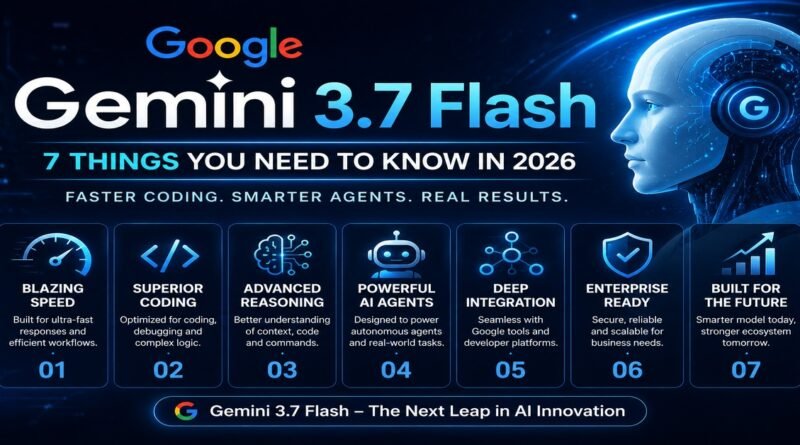
1. Gemini 3.7 Flash Is Built for Coding and AI Agents
The biggest story is not another chatbot benchmark. The model is designed for software engineering, web development and agentic workflows.
That means it can become part of systems that plan tasks, call tools and work through multi-step problems. For developers, this matters because AI coding is moving toward agents that can inspect a project, make changes, test their work and continue iterating.
2. The Flash Model Targets the AI Workhorse Segment
Flash models occupy an important part of the AI market: users want strong intelligence, but they also need low latency and reasonable operating costs.
This is particularly important for AI agents. A single agent task may require dozens of model calls. If each call is expensive or slow, the economics quickly become difficult. Google’s approach is therefore designed around repeated practical use rather than occasional premium queries.
3. Gemini 3.7 Flash Pricing Encourages Agent Development
Google announced introductory API pricing of $0.75 per million input tokens and $3.75 per million output tokens through the end of 2026. The announced regular rates are $1.50 per million input tokens and $7.50 per million output tokens.
Lower inference costs can make a major difference for developers experimenting with autonomous workflows because agents frequently use multiple model calls to complete one task.
4. It Fits Google’s Developer Ecosystem
Developers can access Gemini models through Google’s AI development ecosystem, including the Gemini API and Google AI Studio, alongside broader agent and developer tooling.
This matters because the competition is increasingly about the entire AI platform rather than the model alone. Developers want models, APIs, tools, execution environments and deployment infrastructure that work together.
5. Google Is Pushing Toward Personal AI Agents
Google is also pushing its Gemini ecosystem toward assistants that can perform multi-step work rather than simply answer questions.
The broader direction is clear: instead of asking an AI to explain something, users increasingly want to ask it to complete something. That could mean coordinating information, working across productivity tools or helping manage a longer task.
This is an important change for consumer AI. The next generation of assistants will increasingly be judged by whether they can complete useful tasks reliably, not simply by how natural their answers sound.
6. The Release Comes During a Google AI Reshuffle
The launch comes at an important moment for Google. Reuters reported in August that Alphabet has been reshuffling leadership around Google DeepMind as the company pushes harder to compete in the frontier AI market.
That makes the Flash release strategically significant. Google needs its Gemini family to compete not only with OpenAI and Anthropic but also with a rapidly expanding ecosystem of specialized and open models.
7. One Model Does Not Automatically Make Google the AI Leader
The release is important, but one model does not settle the AI race.
Developers will ultimately compare real-world coding accuracy, latency, reliability, tool use, context handling, price and how well agents recover from failures.
Google has also been building managed-agent infrastructure around its models. That suggests the company’s strategy is broader than releasing individual models: it wants Gemini to become the engine powering complete AI workflows.
Gemini 3.7 Flash vs ChatGPT and Claude
For everyday users, the practical question is not which company has the most impressive announcement. It is which AI assistant performs best for a specific workflow.
| Area | Gemini 3.7 Flash | What Users Should Compare |
|---|---|---|
| Coding | Strong focus | Accuracy, debugging and project context |
| AI agents | Major focus | Tool use and task completion |
| Speed | Flash-oriented | Response latency |
| Cost | Designed for efficient scaling | Total cost per workflow |
| Google ecosystem | Deep integration | Gmail, Docs, Calendar and developer tools |
If you are comparing Google’s AI with ChatGPT, read our ChatGPT vs Gemini AI guide. You can also explore our best AI tools in 2026 and best AI coding assistants.
Why Gemini 3.7 Flash Matters for AI Agents
The most important development may be the shift from standalone AI responses to AI systems that perform work.
Models are increasingly being combined with tools, secure execution environments, APIs and agent orchestration. That makes model speed and cost much more important because an agent may need many calls to complete a single task.
It also raises security questions. As agents gain more permissions, the quality of the underlying model is only one part of the equation. Read our NewsHulk guide on AI agent security in 2026 to understand the risks.
Who Should Try Gemini 3.7 Flash?
Developers: Yes. It is worth testing if you are building coding tools, AI agents or multi-step workflows.
Businesses: It is worth evaluating alongside other models, particularly if your organization already relies heavily on Google Workspace or Google Cloud.
Everyday users: The model becomes most interesting if you want an assistant that can handle complex tasks rather than simply answer questions.
Frequently Asked Questions
What is Gemini 3.7 Flash?
It is Google’s Flash-series AI model focused on fast, efficient performance for coding, AI agents and multi-step workflows.
Is Gemini 3.7 Flash good for coding?
Google is specifically positioning the model for software engineering and coding workflows. Developers should still compare its real-world accuracy and reliability against competing models.
Is Gemini 3.7 Flash cheaper than other AI models?
Google’s introductory API pricing is designed to make repeated model calls more economical, which is particularly useful for applications and AI agents.
Should I use Gemini 3.7 Flash instead of ChatGPT?
There is no universal winner. The best choice depends on the task, including coding, research, writing, integrations, price and the tools available in your workflow.
Final Verdict
Gemini 3.7 Flash is an important release because it reflects where the AI market is heading: faster, more efficient models designed to take action.
Google is betting that the future of AI will not be dominated by one giant chatbot. Instead, models will become engines inside coding assistants, business agents and personal digital workers.
Whether Google’s latest Flash model becomes the preferred AI workhorse will depend on real-world performance. But one thing is already clear: the competition between Google, OpenAI and Anthropic is becoming a competition over AI agents and useful work, not just chatbot answers.